DK3QN's Ham Radio Menu
Home CW QRP rigs QRO rigs Boatanchors Antennas Amplifiers EME SDRs Miscellaneous Impressum email
HF Transceivers with more than 20 watts output
This is a brief introduction to HF RIGs I use or have used in the past. All information is 'work in progress' and
will be updated gradually.
The section also covers some of the less known HF RIGs. This does not mean
that they may function sub-standard
(sometimes even to the contrary)
but due to various reasons are not so familiar to the average HAM
amateur.
This is motivation for me to promote these Rigs a little more on my website.
However, from my point of view, any future development for ham radio equipment will turn into the direction
of "SDR".
So, please consider your expenses if purchasing a new radio, with regard to that comment, for your own sake,
and visit my "SDRs" website.
Buying a new rig: some words of "warning" >>> New: November 2010 <<<
Buying decisions purely based on what other people post in a forum on a particular rig can be a very costly and
disappointing experience.
E.g. on www.eham.net there are - besides a lot of other information - numerous user reviews on all sorts of ham
radio gear to be read in dedicated product categories.
The category "Transceivers: HF Amateur (including HF+6m+VHF models)" shows reviews on 291 different rigs in
this category (03-Nov-2010).
Together with his review on a certain rig, each user also provides his ranking for the rig as a number out of the
range of 0 to 5, where 0 = "very bad" and 5 = "excellent".
Based on the various user reviews for a certain rig, an average rating is indicated for each particular rig.
As of today (03-Nov-2010) the average rating for an Icom IC-718 transceiver e.g. is at 4.6 (based on 367 individual
reviews). The average rating for a Ten-Tec Orion-I is at 4.5 (based on 85 individual reviews).
From that one may conclude that an IC-718 is a bit better transceiver compared to a Ten-Tec Orion-I.
In reality it definitely is not! It is miles away and below the Orion-I (btw.: I have owned both transceivers for
some time so I have a base of real life comparison on the air with both rigs).
Now, why are these ratings such confusing?
After reading through a lot of these eham.net reviews, my personal belief is that - best case - the rating goes
hand in hand and is linked to the purchase price and/or price-performance positioning of the rig.
If I buy a $ 700 radio I most likely don't expect a stellar performing radio but I'm pleased if it works ok for
my average useage. So I may give it a rating of "5". It fits my bill.
If I buy a $ 3,300 radio I do spend quite some more money on the radio and as a consequence I do expect
a lot from this radio, in fact I expect a stellar performer for all sorts of useage scenarios.
Maybe I find some of the knobs a bit too small or I would prefer a different color for the LCD backlight.
So I may give it a rating of "4".
From this it is quite obvious that any buing decision predominantly based on such kind of rating behavior
is more than questionable.
The ratings need to be seen in the context of money spent vs. individual expectations. They don't usually
give an absolute indicator on a rigs' performance as such.
A recently introduced Icom IC-7600 transceiver has a current user rating of 4.6. The very same rating as
the IC-718. Now in reality no one would seriously argue that the performance level between both radios
is exactly the same as the rating may pretend.
Watch out for this before spending your $$ for a new transceiver!
Where to get a meaningful judgment on a specific rig?
My primary source for obtaining largely unbiased information on rigs' functions and performance are
detailed product reviews done by well-known ham radio periodicals.
Probably the most famous periodical is "QST" magazine published by the ARRL. In each issue they do have
a review section where various sorts of ham radio equipment is being reviewed. Primary focus of these
reviews is around HF transceivers (the subject of this web page). In general they come up with a review
on a newly introduced rig soon after it has been released for shipment in the US. And new rigs are sold
and shipped in the US first before they hit the market in other regions such as the EU.
QST is quite a realtime source for reviews on new products. Besides that there are many other sources
like "CQ DL" magazine or "Funkamateur" here in DL-land.
Advice web page for "HF Newbies" see here.
New to the shack (August 2009):
Yaesu FT-450AT HF transceiver:
(NEW: hints for the FT-450 foot bar please see here)
The latest addition to my shack (after the Flex-3k) is the Yaesu
FT-450AT. This is a substitute for my former Icom IC-7000,
which I finally sold because of the felt inconveniance with it's menue system, which I never could get accustomed to.
The FT-450AT has a much, much simpler menue system. As per it's nature, I don't operate my /portable rigs too often
within a year, so the simplicity of the menue system for me plays a significant role as I don't want to dig into the manual
whenever I intend to operate the radio /p.
There have been quite a number of test reports on the FT-450, saying it's a "dog". However, my current findings on my
local antennas show, it's not really a "dog". Indeed, it performs pretty well on my antennas. Well, the built-in speaker
is rather poor re. audio quality, but this dramatically changes into "good" as soon as you connect a decent external
speaker into the back panel LS connector.
The transmitted TX audio is also quite ok when driving the rig with a Heil headset and HC-4 mike capsule. I have a rather
dark voice by nature and have chosen the HC-4 mike element in order to get more midths and heights in my TX audio
to be better readable if things are getting tight on the band. Running the rig in TX equalizer function set to "flat"
produces a real crisp and clean audio. If your particular voice is more high-pitched you should consider the HC-5 mike
element instead.
CW QSK is not so well implemented, it's a compromise, but works rather ok in semi-bk, which is ok for me, as I don't
run in CW QSK so much anyway.
The internal antenna tuner, although spec'd to tune a 3:1 SWR at max., in my case tunes my trapped dipole on 80m CW
down there in the CW band with a much higher SWR than 3:1.
Antenna tuner test: yesterday (03-Sep-2009), just for curiosity, I did a quick tuner test and I let the tuner try to match my
80/40/30m trap dipole on the the higher bands, where the antenna is not designed for (bad SWR). On every single band,
20/17/15/12 and 10m, the tuner did match the antenna to an SWR very close to or even equal to 1:1. As soon as I have
some more time, I will investigate this in more detail and update the findings right here.
The built-in speech memories (3 each 10 seconds) are great for recording your "CQ" call messages and save your voice
whenever running the rig in a contest. Very well done add-on included. The only complaint re. the set-up of this function
is the way of how you need to implement this. However, this is mainly true for a multi-OP environment.
For the price you need to pay for the rig it's a good first-time rig or a good back-up or /p rig.
At the time of my purchase (August 2009) the rig sold for Euro 599 w/o built-in antenna tuner and for Euro 699 with the
built-in tuner. I'd recommend to invest the extra 100 Euro and get the "AT" version with tuner.
I will put the rig through parts of the upcoming IARU Region-1 SSB fieldday and will report on the findings right here.
Update 05-Jan-2010:
Besides the September 2009 IARU Region-1 fieldday (see below) I've used the FT-450 during the DARC Xmas Contest 2009
in CW mode only (contest bands are 80 & 40m).
The rules for this contest are a bit strange, IMHO, as they are not seen in any other contest as far as my knowledge goes.
The calling station needs to QSY after his/her QSO to another QRG in order to start another CQ. This leads to a sort of
'messy' band as after a QSY the callers on average do not properly check if the new frequency is already in use or not.
This 'messiness' is augmented by the fact that the contest only lasts for 2 1/2 hours. A pretty limited time span causing
sort of a real hectic state in order to get as many as possible QSOs and multipiers logged in that time frame.
What happens is that somebody starts calling CQ on top of your QSO where you are just trying to receive your partner's
QSO exchange. Damn...
So, this contest, besides it's intrinsic 'craziness', is a real challenge to TRX/RX performance with main respect to the
RX capabilities. To take a positive view out of it, it gives you a profound feedback on the RX/TRX reception capabilities
within a very short time frame.
To make the story short:
With the FT-450, blocking or 3rd order IMD was not the issue. What was an issue was the fact that the minimum 500 Hz
DSP filter bandwidth (the most narrow bandwidth you can dial-in in CW with this transceiver) is just not good enough
(narrow enough) in order to deal with such a contest environment.
To deal with such a kind of environment would require a filter bandwidth (CW) of minimum 250 Hz, better down to
125 and narrower, in order to cope with the close-in QRM during this kind of a contest.
This is where the FT-450 gets 'out of steam'. Due to it's 500 Hz DSP filter it runs into 'problems' as soon as there are
multiple strong stations within that pass-band.
During this 'strange' contest I was able to 'rescue' a number of my QSOs and finish them with a 2-way QSO exchange
by tuning the 'Shift' control appropriately, which helped in many cases. However, I must say, that the IF DSP filtering
at 500 Hz minimum bandwidth is definitely not what makes you happy in such a case. It is more of the sort of 'offending'.
I am calling this 'offending' deliberately, because I believe Yaesu could do much better without significantly increased
cost (if any, maybe just a DSP firmware upgrade) even with a radio in this class.
@Yaesu: if you are reading this: please reconsider your concept for the FT-450 CW RX DSP circuitry and/or firmware.
My 'wish list':
> implement a 250 Hz CW DSP filter (minimum, or narrower)
> implement a 5 KHZ (or narrower) roofing filter, forget the FM capability
> you may ask an additional amount of 50 to 100 Euros for these efforts
> that would put you well into the lead vs. your next competitor
Else: under standard rag-chewing QSOs (SSB and CW) the FT-450 is performing quite well. For the price you need to
pay for the TRX it makes the purchase of 2nd hand transceivers dated from the 80s or 90s almost obsolete.
Except if you are fond of those days' equipment (and *yes*, there are a few arguements coming with it).
Update 11-Dec-2009:
We've run the FT-450AT over several hours during the 2009 IARU Region-1 SSB fieldday. Operation was during the night
on 40 and 80m. The rig behaved astonishingly well under these circumstances. On these bands, the pre-amp needs to be
switched-off, for sure. In Yaesu language this means 'IPO on'!
Antennas in use were an 80m pyramide antenna and a 40m full-size vertical ground-mounted ontop of a 'chicken-mesh'
kind of rf ground system consisting of 2 'X' runs of 10m by 1m chicken-mesh ground system.
Performance both on 80m and 40m was exceptional! Power output was 100 watts.
to be continued...
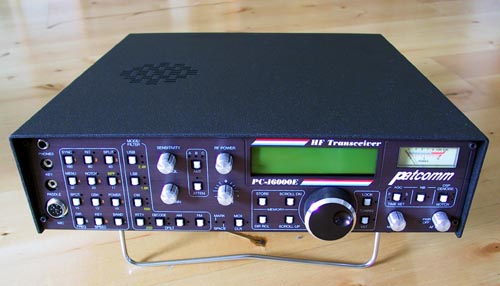 Patcomm PC-16000E
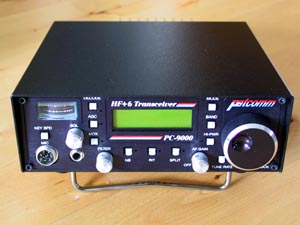 Patcomm PC-9000
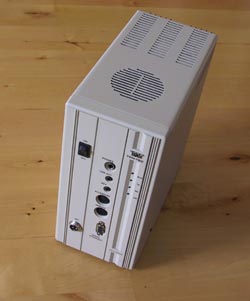 Ten-Tec Pegasus